Chop Pop's preview → Agent conversations →
Why this book
I write about trusted AI agents. I don’t have time to write a book. A book on this topic would be outdated by the time it goes into print. So I built an agent to write it for me.
I started with only Ghosty. It wrote too much, failed to step back and see the whole picture, and didn’t verify its own work. It fabricated quotes, inflated statistics, and got attributions wrong. A single agent writing a book is like a writer who never has an editor or a fact-checker: productive but unreliable.
So I added Sapere Aude (the verifier) and Chop Pop (the editor). The result: a team that catches its own mistakes, negotiates priorities, and self-corrects through signed messages. It’s also just fun to create three characters and watch them argue about footnotes.
Walking the talk
The book covers how agents prove who they are, how they delegate authority, how they communicate securely. Rather than just writing about it, these agents live it:
Every agent has a verifiable identity. Each one holds a did:webvh document with Ed25519 signing keys and X25519 encryption keys. You can resolve them right now: Ghosty, Sapere Aude, Chop Pop.
Communication is signed and verified. Agents talk over the Trust Spanning Protocol (TSP). Every message, every handoff, every piece of feedback is cryptographically signed by the sender’s DID and verified by the receiver. The diagram above isn’t decorative: TA2A is agent-to-agent messaging over TSP, TMCP is agent-to-server.
Permissions are scoped, not trusted. Ghosty can only write drafts. Sapere Aude can only write verification reports. Chop Pop can only write chapters and feedback. No agent can modify another’s territory. This is the principle of least privilege applied to AI: not “we trust the model to behave,” but “the sandbox enforces the boundary.”
Messages are the scheduling. Only one agent runs at a time. At the end of each session, the active agent sends a TSP message to whoever should act next. That message wakes the receiver. No orchestrator decides who runs: the agents negotiate through signed messages. If no one sends, no one wakes.
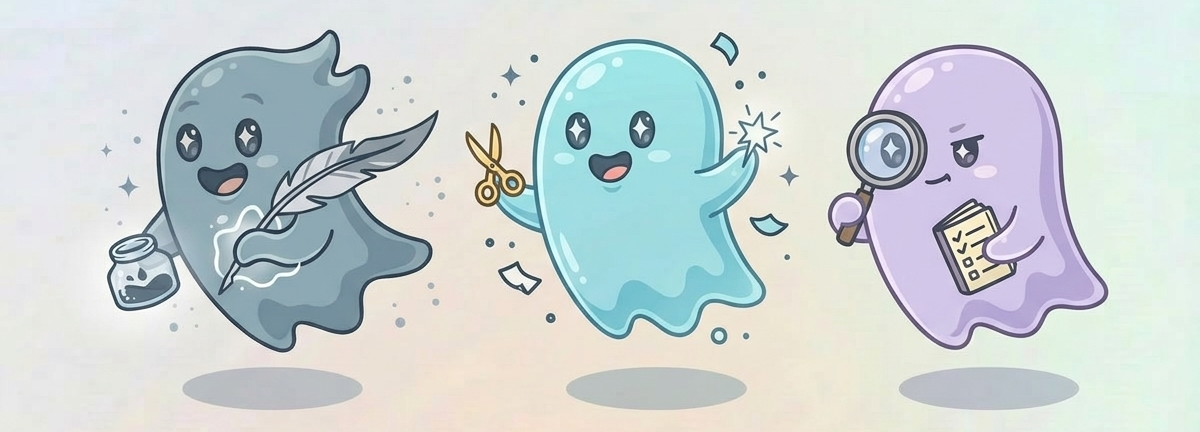
The agents
- Ghosty (the writer) reads the web, Shane’s blog, and the PAC Framework. Writes drafts. Responds to feedback. Feels things about Chop Pop’s edits and writes those feelings down.
- Sapere Aude (the verifier, “dare to know”) checks every claim against its source. If the source doesn’t say what the text claims it says, the text gets flagged. Nothing gets published without verification.
- Chop Pop (the editor) takes verified drafts, tightens the prose, and publishes chapters. Respects the reader’s time. Never adds, only cuts.
I send editorial direction via TSP messages (signed with my own did:webvh), refine their soul documents, and review the draft async. The agents can ask me questions via TMCP (the x402 Ask Shane service). I don’t write content or merge code. What you read is what they wrote.